Vaccines are meant to be kept cold.
They are not meant to be frozen.
That sounds simple enough, but it is one of the more common traps in vaccine storage. When people think of a frozen vaccine, they often imagine something obvious. Ice in the vial. A cracked container. A wet box. A cloudy mess that clearly looks wrong.
Sometimes freezing will leave visible signs.
But often, it will not.
A vaccine may be exposed to freezing temperatures overnight, thaw before anyone opens the fridge, and look perfectly normal by the morning. The vial may look fine. The box may look fine. The liquid may look fine.
That does not mean the vaccine is safe to use.
Australian vaccine storage guidance is clear that vaccines should generally be stored between +2°C and +8°C, with +5°C as the target. The current Strive for 5 guidelines also state that many vaccines can be destroyed by freezing or repeated freeze-thaw cycles, and that this may not be visually observable.
Why freezing matters
Some vaccines are damaged when they freeze.
This is especially important for vaccines that contain aluminium-based adjuvants. These ingredients help the immune system respond to the vaccine. In these vaccines, freezing can disturb the aluminium-containing suspension. The aluminium component can separate, clump together and settle differently.
That is not just a cosmetic problem.
If the vaccine has been damaged, it may not work as expected. The patient may receive a vaccine that looks acceptable but does not provide the protection it should.
That is why “it looks fine” is not a safe decision.
What might a frozen vaccine look like?
Sometimes there may be visible warning signs.
You might see particles, clumps, flakes, unusual cloudiness, sediment, a colour change, a cracked vial, a displaced stopper, wet packaging or damage to the box.
But those signs are not reliable.
A vaccine can be affected by freezing and still look normal to the person checking the fridge. The absence of visible damage does not prove that the vaccine is usable.
The better question is not “Does it look frozen?”
The better question is “What does the temperature record show?”
So the answer to our question “Can you tell if a vaccine has frozen by looking at it?” is a resounding NO.
Hang on, what about the Shake Test?
There is a method called the Shake Test.
The Shake Test was designed to detect freeze damage in aluminium-based, adsorbed, freeze-sensitive vaccines. The PAHO/WHO job aid gives examples including DTP, DT, Td, TT, typhoid and hepatitis B vaccines.
This point matters.
- The Shake Test is not a general test for every vaccine in the fridge.
- It is not a way to clear all stock after a cold chain breach.
- It is not suitable for every vaccine type.
- It is only relevant to certain freeze-sensitive vaccines where freezing changes the way the suspension settles after shaking.
In other words, the Shake Test is useful for a specific problem: checking whether certain adsorbed vaccines may have been damaged by freezing.
It is not a general “is this vaccine still okay?” test.
How the Shake Test works
The Shake Test compares two vials.
One vial is deliberately frozen and then completely thawed. This becomes the frozen control vial.
The other vial is the suspect vial. This is the vaccine that may have been exposed to freezing.
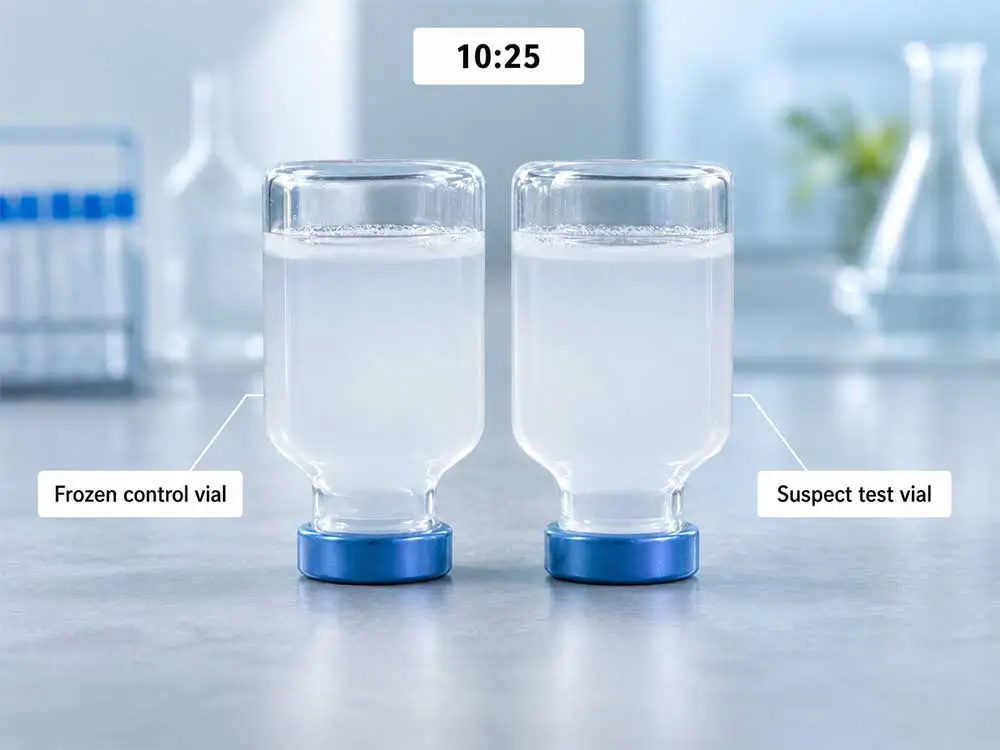
Both vials are shaken vigorously, then placed side-by-side and left to settle.
This slightly weird WHO video shows the procedure.
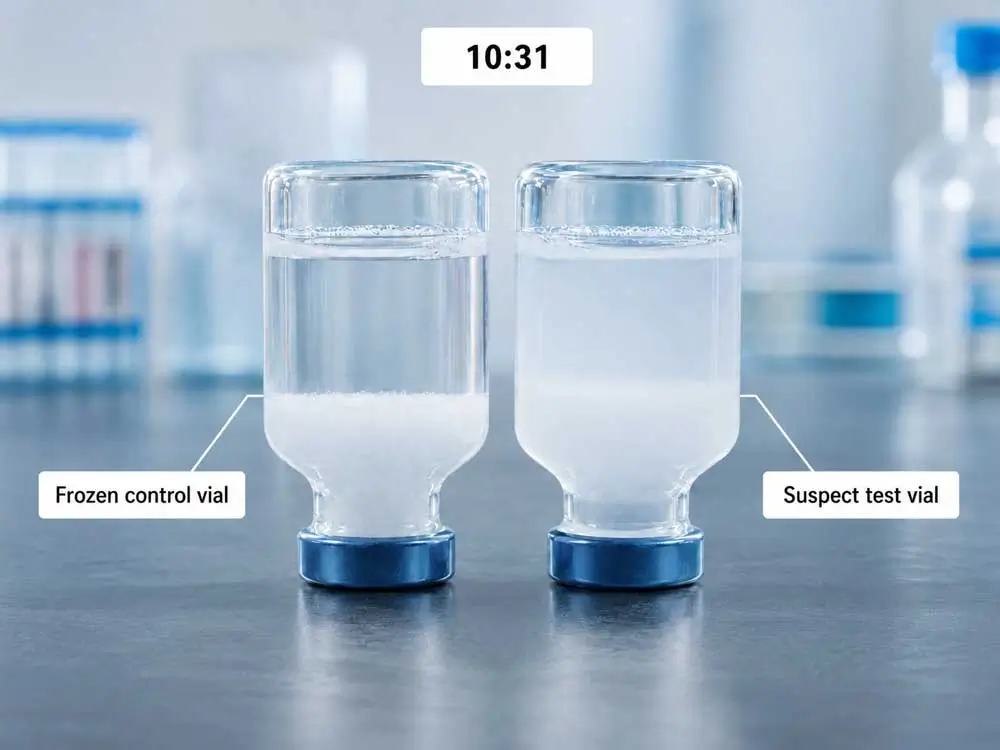
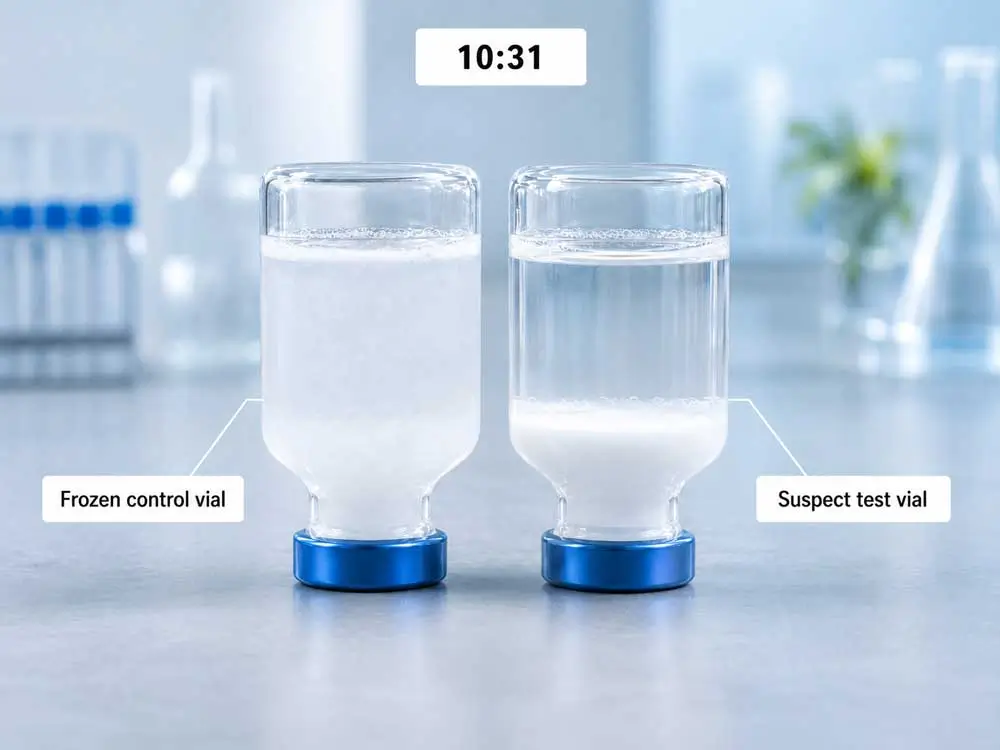
If the suspect vial settles more slowly than the frozen control vial, the PAHO/WHO job aid says it can be used. If the suspect vial settles at the same speed as the frozen control, or faster, it should not be used.
A useful way to think of it is this:
> Frozen, damaged vaccine tends to settle faster.
> Unfrozen vaccine tends to remain more evenly cloudy for longer.
That is the visual comparison shown in the Shake Test images. The frozen control vial develops a clearer upper layer and heavier sediment more quickly. The suspect vial, if it has not been frozen, settles more slowly.
SHAKE TEST PASS
SHAKE TEST FAIL
Why the Shake Test needs care
The Shake Test sounds simple, but it should not be treated as a quick guess.
For the result to mean anything, the control vial needs to be the correct comparison. Training material describes using a vial of the same vaccine type, and ideally the same manufacturer and batch, then freezing it solid, thawing it, shaking it with the suspect vial and comparing the sedimentation rate.
The observation also needs to be done properly. The Open University cold chain training material describes shaking the control and test vials together for 10-15 seconds, placing them side by side, and comparing how quickly the sediment settles. It also notes that some vial labels can make the contents hard to see, in which case the vials may need to be turned upside down so sedimentation can be observed in the neck.
So, while the Shake Test is a recognised method, it is not something to improvise casually at the fridge door.
- It needs the right vaccine.
- It needs the right control vial.
- It needs the right process.
And it needs someone who knows how to interpret what they are seeing.
When can the Shake Test be used?
The Shake Test may be relevant when there is a concern that a freeze-sensitive, aluminium-adjuvanted vaccine has been exposed to freezing conditions.
Examples include situations where:
- The fridge temperature record shows a drop below the safe range.
- A freeze indicator has been activated.
- Vaccines may have been placed too close to a cold wall, freezer plate or cold air outlet.
- Vaccines may have touched frozen ice packs during transport.
- A vaccine has been stored in a fridge with known cold spots.
Training material also notes that there is no need to perform a Shake Test if a liquid vaccine vial is already frozen solid. In that situation, it has clearly frozen.
When should the Shake Test not be used?
The Shake Test should not be used as a blanket test for all vaccines.
- It should not be used for vaccines that are not aluminium-based adsorbed vaccines.
- It should not be used to ignore a cold chain breach.
- It should not be used without checking the vaccine’s storage requirements and local guidance.
- It should not be used as a replacement for official advice from your state or territory health department, vaccine supplier or manufacturer.
This is especially important in Australia.
Current Australian Government advice says not to use vaccines exposed to temperatures below +2°C or above +8°C without getting further advice. It also says not to discard them until advice is received. For National Immunisation Program vaccines, providers should isolate the vaccines and contact the state or territory health authority. For privately purchased vaccines, they should contact the manufacturer or supplier.
What to do if freezing is suspected
If you think vaccines may have frozen, do not use them.
- Do not put them back into normal stock.
- Do not discard them straight away unless you have been told to.
Keep the vaccines stored between +2°C and +8°C, separate them from usable stock, and clearly label them Do not use / Do not discard.
Download the data logger report and record what happened, including the lowest temperature reached, how long the fridge was out of range, which vaccines were affected, and whether any vaccines were near a cold wall or air outlet. The Strive for 5 breach information specifically asks for details such as the minimum and maximum temperatures, the length of time outside range, the vaccines involved, batch numbers, expiry dates and whether vaccines were pushed against a cooling plate or cold air outlet.
Then follow your cold chain breach process.
The Shake Test may be part of technical assessment in some settings for some vaccines, but the first response is still the same: isolate, label, keep cold, document and seek advice.
The real lesson from the Shake Test
The Shake Test is useful because it shows something important.
Freeze damage is not always obvious at first glance.
Two vials can look similar immediately after shaking. A few minutes later, the damaged vial may settle faster. The difference is in the behaviour of the suspension, not necessarily in the way the vial looks when someone first picks it up.
That is exactly why visual checks alone are not enough.
You need the temperature record.
You need a clear breach process.
And, where a Shake Test is appropriate, it needs to be done properly and only for the vaccine types where the test is valid.
Key takeaway
You cannot reliably tell if a vaccine has frozen just by looking at it.
The Shake Test can help detect freeze damage in some aluminium-adjuvanted, adsorbed vaccines, such as DTP, DT, Td, TT, typhoid and hepatitis B vaccines. But it is not a general test for all vaccines and should not replace your cold chain breach process.
If freezing is suspected, isolate the vaccines, label them Do not use / Do not discard, keep them between +2°C and +8°C, check the temperature records and seek the correct advice.